Audit
Software audit
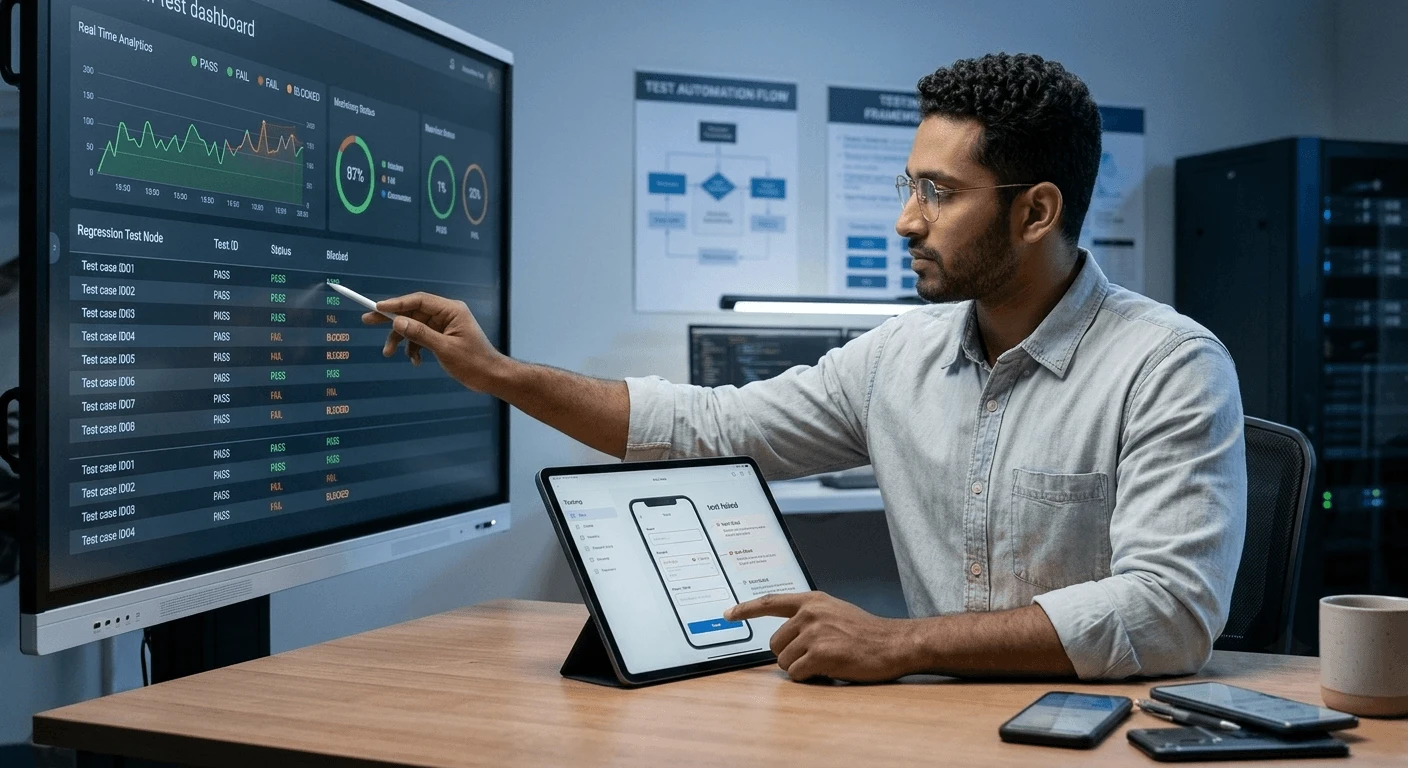
A full review of your code quality, test coverage, security, user experience and integration layer. You see where to improve, and the integrity of your product is protected.

Tailored quality assurance and testing that helps you launch a robust, user-friendly product, up to 80% faster and at 20% lower cost.
Guided through the entire journey by leading tech and business experts.
A full review of your code quality, test coverage, security, user experience and integration layer. You see where to improve, and the integrity of your product is protected.
We help you build responsive, stable and scalable applications, in a testing timeframe up to 80% shorter.
Automated bug detection removes human error and tests how resilient your software is, cutting manual QA costs by up to 20%.
Every feature checked against your requirements.
New releases never break what already works.
Endpoints, data and integrations verified end to end.
Vulnerabilities found before attackers find them.
Know how your app behaves at peak traffic.
Real iOS and Android devices, screen sizes and OS versions.
Consistent behaviour in every major browser.
Real users show where the experience gets in the way.
QA that pays for itself: a better product, a faster release and a smaller bill for fixes.
Performance testing tackles peak load, responsiveness, security and stability long before your users touch the product, so you avoid lags or downtime that could harm your brand.
Performance and test automation built into continuous integration and deployment can get your product to market up to 80% faster. Issues are caught early, at every stage, so there is less rework.
Issues found early in the development life cycle are much cheaper to fix. Test automation can cut testing costs by up to 20%, and your custom test scripts can be reused at no extra cost.
Continuous quality assurance lets you respond quickly to what customers ask for, and frees your team to focus on growing the business.
Testing runs alongside development, not after it, so problems are caught while they are cheap to fix.
We study your product, users and risks, and agree what “done” and “good” mean.
A test strategy, test cases and the right mix of manual and automated testing.
Testing runs every sprint, inside your CI/CD pipeline, on real devices and browsers.
Clear bug reports with steps to reproduce, then retesting until every fix is confirmed.
Can’t find what you’re looking for? Get in touch and we’ll answer it.
Usually both. Automated tests are best for checks that repeat on every release, such as regression, API and load tests. Manual testing is better for new features, usability and edge cases that need human judgement. We recommend the mix after looking at your product.
As early as possible. When testers join during planning, requirements are clearer and bugs are caught while they are still cheap to fix. Testing late in the cycle is where delays and budget overruns usually come from.
Yes. We often start with a software audit of an existing product, then set up test cases and automation around it. We can work alongside your developers or an outside vendor.
We choose them to suit your stack and pipeline, so the tests fit into how your team already works. Automated tests run in your CI/CD, for example GitLab or Docker-based pipelines, on every build.
Discover how smart footwear transforms raw IMU sensor data into meaningful gait and movement insights. Explore sensor fusion, real-time data processing, and time-series analytics that power smarter, more personalized wearables.
A designer creates the interface in Figma, and then the developer studies the design, checks spacing, identifies colors and typography, downloads assets, understands component states, and finally translates everything into HTML, CSS, JavaScript, React, or another frontend technology.
As pull request volume grows, code review can quietly become the bottleneck. This article explores how AI-generated code, larger PRs, and shallow reviews can increase downstream rework—and what teams can do to maintain review quality.


